Kekayaan akan informasi yang sekarang tersedia di Internet telah lebih mencapai harapan dan bahkan imajinasi dari para penemu system yang pertama. Internet awalnya diciptakan untuk kebutuhan system pertahanan militer supaya dapat didesentralisasikan sehingga dapat mengurangi resiko kerusakkan total, mungkin saja hal inibisa terjadi apabila sistem sentral komputer utama dimusnahkan.
Internet juga dapat didesentralisasikan dan diberdayakan. Dengan menggunakan internet kita dapat mengakses sumber-sumber informasi tanpa batas dan sedang berkembang secara cepat sekali. Kita dapat berkomunikasi secara masing-masing atau secara massa yang dapat dilakukan dimana saja diseluruh dunia hanya dalam waktu beberapa detik saja. Kita dapat menyebarkan (publish) informasi yang bisa di akses dari mana saja di seluruh dunia dalam waktu singkat sekali. Kita dapat berkomunikasi secara langsung (real time) melalui telepon dan unit video processing. Kita bisa melakukan "chat" melalui jaringan gratis "chat" yang sangat luas yaitu mIRC.
Bagi para guru internet menawarkan beberapa kesempatan untuk diraih:
Pengembangan Profesional
(a) Meningkatkan pengetahuan
(b) Berbagi sumber diantara rekan sejawat/ sedepartemen
(c) Bekerjasama dengan guru-guru dari luar negeri
(d) Kesempatan untuk menerbitkan /mengumumkan secra langsung
(e) Mengatur komunikasi secara teratur
(f) Berpatisipasi dalam forum dengan rekan sejawat baik local maupun internasional.
Sumber bahan mengajar :
(a). Mengakses rencana belajar mengajar & metodologi baru
(b). Bahan baku & bahan jadi cocok untuk segala bidang pelajaran
(c). Mengumumkan dan berbagi sumber. Sangat tingginya popularitas / sangat tingginya minat untuk meningkatkan siswa lebih terfokus belajar.
Untuk siswa Internet menawarkan kesempatan untuk;
Belajar sendiri secara cepat :
(a). Meningkatkan pengetahuan
(b). Belajar berinteraktif
(c). Mengembangkan kemampuan di bidang penelitian
Memperkaya diri :
(a). Meningkatkan komunikasi dengan siswa lain
(b). Meningkatkan kepekaan akan permasalahan yang ada diseluruh dunia
Walaupun Internet berpotensi untuk menyampaikan keuntungan-keuntungan tersebut bagi para guru maupun para siswa, pemakaian Internet di kelas hendaknya harus disusun sedemikian rupa dengan belajar mendefisinasikan secara obyektif. Kegiatan siswa juga harus dimonitor dengan baik.
Selasa, 17 November 2009
Manfaat internet untuk siswa dan guru
Senin, 02 November 2009
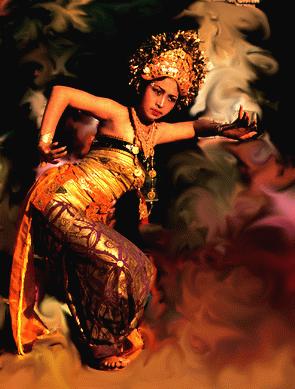
Dance, Music, and Theaters of Bali
|  | ||||||||||
| | |||||||||||
Garuda Wisnu Kencana
Garuda Wisnu Kencana Cultural Park: Jimbaran, Bali
 The 50 or so visitors milling around the 20-hectare Garuda Winsu Kencana cultural park in Jimbaran looked small in comparison to their surroundings.
“It’s like visiting a cemetery,” said a young girl watching the sunset from the park, which sits on a hill south of Denpasar.
The beautiful and serene park, overlooking Jimbaran Bay, was originally meant to be the best cultural park in Indonesia, and maybe, one day, the world.
But now it is just another remnant of the New Order regime, part of an ambition to build world-class landmarks to compete with iconic structures like the Statue of Liberty in New York.
Under the auspices of Soeharto, local artist I Nyoman Nuarta was commissioned to create a huge statue of Wisnu, the god of creation, sitting on Garuda, the mythical bird that carries him, with a final height greater than that of the Statue of Liberty.
The park was also to be equipped with a performance center with 7,500 seats, and ampitheather, a street theater, galleries, restaurants and other artistic attractions.
Problems began to emerge almost as soon as construction started in 1997, with the budget ballooning to hundreds of billions of rupiah.
The park was initially the idea of the Garuda Wisnu Kencana Foundation, a grouping that included then minister of tourism and telecommunications Joop Ave, then mining and energy minister IB Sudjana, along with Nuarta and several other influential individuals and businessmen close to Soeharto.
It was to be built in the rocky and hilly area of Jimbaran, which present new logistical problems. The hills had to be cut flat to create the area required for the statue, which is still not finished today. Only the head and torso of Wisnu have been completed.
Land clearing was also an early problem. A 250-hectare plot of land, 100 hectares of which belonged to Badung regency, and the rest to residents, was required. Ten years later, there are still disputes over the matter.
“The clearing program with the local residents has not yet been solved properly,” said Anak Agung Ngurah Rai Riauadi, the park’s public relations manager.
Management of the park’s construction was not effective because so many people shared their ideas and wanted to see them put in place, “which were of course very difficult to accommodate,” he added.
The monetary, social and political crises between l997 and l998 worsened the situation. The fall of the Soeharto administration badly affected the project badly.
Today, only 20 percent of the original project has been completed, and construction was halted entirely in September 2004.
Earlier this year, President Susilo Bambang Yudhoyono promised to fins investors to continue the project.
“I promise to you that we will finish the project. It is the pride of the nation,” the President said in a speech.
I Made Mangku Pastika, former head of the Bali Police, was then appointed chairman of the foundation, while Edi Sukamto, owner of the Kuta Galeria Shopping center, was made the park’s director.
“We will continue building the park in May 2008 to commemorate National Awakening Day,” said Mangku Pastika.
However, money will always be a lingering problem for the project. Only a very few investors are eager to invest in cultural projects.
Creative and innovative ideas are needed to enliven the park with various cultural activities, while business activities are needed to make shoppers comfortable.
“It is very sad to enter an empty gallery with no art objects and visitors,” said Anna, a visitor and art student.
Silence day, for make a better world
Bali's day of silence |  | |  | |
Every religion or culture all over the world has their own way to define and celebrate their new year. For example, the Chinese have the Imlek year and to celebrate it, have, as they called it in their own language, "Gong Xi Fat Choy". The Moslem societies have their Muharam year, and any of the people over the world using the Gregorian calendar, celebrate the New Year on January 1st.
The same thing also occurs in Bali, however the Balinese use many different calendar systems. They have adopted the Gregorian calendar for business and government purposes. But for the endless procession of holy days, temple anniversaries, celebrations, sacred dances, building houses, wedding ceremonies, death and cremation processes and other activities that define Balinese life, they have two calendar systems. The first is the Pawukon (from the word Wuku which means week) and Sasih (which is means month). Wuku consists of 30 items starting from Sinta, the first Wuku and end up with the Watugunung the last one. The Pawukon, a 210-day ritual calendar brought over from Java in the 14th century, is a complex cycle of numerological conjunctions that provides the basic schedule for ritual activities on Bali. Sasih, a parallel system of Indian origin, is a twelve month lunar calendar that starts with the vernal equinox and is equally important in determining when to pay respect to the Gods.
Westerners open the New Year in revelry, however, in contrast, the Balinese open their New Year in silence. This is called Nyepi Day, the Balinese day of Silence, which falls on the day following the dark moon of the spring equinox, and opens a new year of the Saka Hindu era which began in 78 A.D.
Nyepi is a day to make and keep the balance of nature. It is based on the story of when King Kaniska I of India was chosen in 78 A.D. The King was famous for his wisdom and tolerance for the Hinduism and Buddhism societies. In that age, Aji Saka did Dharma Yatra (the missionary tour to promote and spread Hinduism) to Indonesia and introduce the Saka year.
The lead upto Nyepi day is as follows:
- Melasti or Mekiyis or Melis (three days before Nyepi)
Melasti is meant to clean the pratima or arca or pralingga (statue), with symbols that help to concentrate the mind in order to become closer to God. The ceremony is aimed to clean all nature and its content, and also to take the Amerta (the source for eternal life) from the ocean or other water resources (ie lake, river, etc). Three days before Nyepi, all the effigies of the Gods from all the village temples are taken to the river in long and colourful ceremonies. There, they have are bathed by the Neptune of the Balinese Lord, the God Baruna, before being taken back home to their shrines. - Tawur Kesanga (the day before Nyepi)
Exactly one day before Nyepi, all villages in Bali hold a large exorcism ceremony at the main village cross road, the meeting place of demons. They usually make Ogoh-ogoh (the fantastic monsters or evil spirits or the Butha Kala made of bamboo) for carnival purposes. The Ogoh-ogoh monsters symbolize the evil spirits surrounding our environment which have to be got rid of from our lives . The carnivals themselves are held all over Bali following sunset. Bleganjur, a Balinese gamelan music accompanies the procession. Some are giants taken from classical Balinese lore. All have fangs, bulging eyes and scary hair and are illuminated by torches.The procession is usually organised by the Seka Teruna, the youth organisation of Banjar. When Ogoh-ogoh is being played by the Seka Teruna, everyone enjoys the carnival. In order to make a harmonic relation between human being and God, human and human, and human and their environments, Tawur Kesanga is performed in every level of society, from the people's house. In the evening, the Hindus celebrating Ngerupuk, start making noises and light burning torches and set fire to the Ogoh-ogoh in order to get the Bhuta Kala, evil spirits, out of our lives. - Nyepi
On Nyepi day itself, every street is quiet - there are nobody doing their normal daily activities. There is usually Pecalangs (traditional Balinese security man) who controls and checks for street security. Pecalang wear a black uniform and a Udeng or Destar (a Balinese traditional "hat" that is usually used in ceremony). The Pecalangs main task is not only to control the security of the street but also to stop any activities that disturb Nyepi. No traffic is allowed, not only cars but also people, who have to stay in their own houses. Light is kept to a minimum or not at all, the radio or TV is turned down and, of course, no one works. Even love making, this ultimate activity of all leisure times, is not supposed to take place, nor even attempted. The whole day is simply filled with the barking of a few dogs, the shrill of insect and is a simple long quiet day in the calendar of this otherwise hectic island. On Nyepi the world expected to be clean and everything starts anew, with Man showing his symbolic control over himself and the "force" of the World, hence the mandatory religious control. - Ngembak Geni (the day after Nyepi)
Ngembak is the day when Catur Berata Penyepian is over and Hindus societies usually visit to forgive each other and doing the Dharma Canthi. Dharma Canthi are activities of reading Sloka, Kekidung, Kekawin, etc.(ancient scripts containing songs and lyrics).

Ubud, The Tourism Village in Bali

Ubud is located 35 km northeast of Bali's International Airport. It is attractive to tourists for a variety of reasons. On a relatively small island with a horde of attractions, Ubud is centrally located, and even the closest beach is only 15 minutes away.
The Ubud area is around two- to three hundred meters above sea level and surrounded by rice fields, which makes it noticeably cooler than then other tourist destinations in Bali. Neighbouring villages are well known for unique bamboo crafts and furniture, wood- and stone carving and many other crafts.
Ubud is famous for it's regularly nightly traditional dance performances, which are part of the traditional culture and are arranged for tourists on a regular schedule. Hindu-Balinese ceremonies take place on a nearly daily basis, especially in the European summer, which is the driest and coolest season here.
Ubud is popular in part today because it is the best place in Bali to break out of the tourist mode and get off the beaten path, although far from undiscovered. Hotels are plentiful; home stays and Indonesian guesthouses (losmen) are easily available to the foreign tourist. Many tourists simply base their entire stay in the city and travel to other destinations from Ubud.
Accommodations in Ubud are also somewhat more reasonably priced than in the beach towns of Bali. But atmosphere is perhaps the major attractions. One visitor summed it up this way: Kuta is madness, Sanur is sterile, and Nusa Dua is culturally isolated; Ubud is the place to go.
The Ubud area is around two- to three hundred meters above sea level and surrounded by rice fields, which makes it noticeably cooler than then other tourist destinations in Bali. Neighbouring villages are well known for unique bamboo crafts and furniture, wood- and stone carving and many other crafts.
Ubud is famous for it's regularly nightly traditional dance performances, which are part of the traditional culture and are arranged for tourists on a regular schedule. Hindu-Balinese ceremonies take place on a nearly daily basis, especially in the European summer, which is the driest and coolest season here.
Ubud is popular in part today because it is the best place in Bali to break out of the tourist mode and get off the beaten path, although far from undiscovered. Hotels are plentiful; home stays and Indonesian guesthouses (losmen) are easily available to the foreign tourist. Many tourists simply base their entire stay in the city and travel to other destinations from Ubud.
Accommodations in Ubud are also somewhat more reasonably priced than in the beach towns of Bali. But atmosphere is perhaps the major attractions. One visitor summed it up this way: Kuta is madness, Sanur is sterile, and Nusa Dua is culturally isolated; Ubud is the place to go.
Langganan:
Postingan (Atom)


